Back to all cases

Modern maps and travel-time guidance improve food security for thousands every day.
Key benefits of building with Mapbox
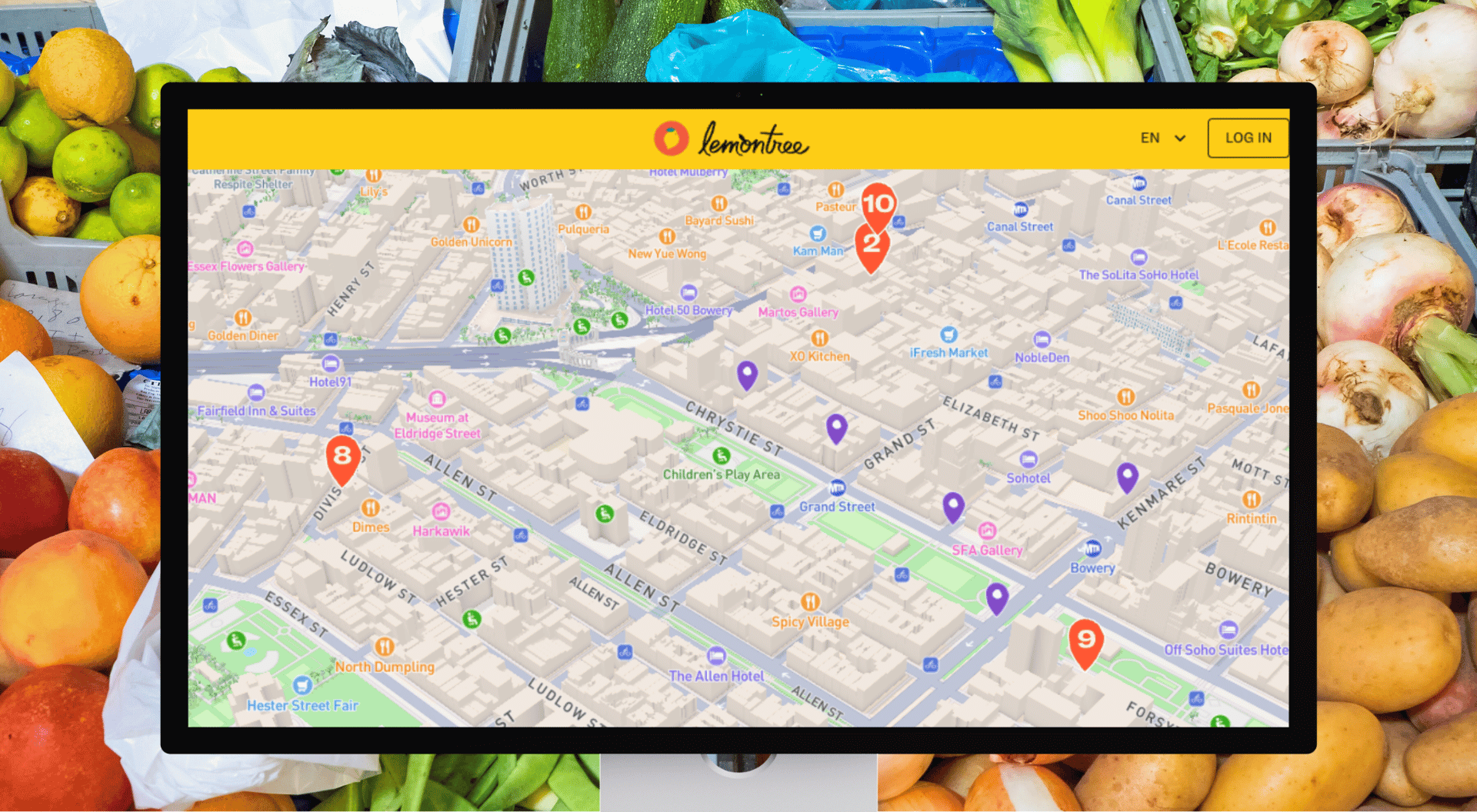
- The Mapbox Directions API provides travel-time details to help to match individuals to food resources that are actually easiest to reach.
- Customized, easy-to-use maps elevate a joyful user experience and support decision-making.
- Mapbox Boundaries provide ZIP code data to visualize impact and service areas in internal and partner dashboards.
products used
About Lemontree
Lemontree is a tech-enabled food platform that makes visiting a food pantry easier and more accessible. Through SMS, WhatsApp, a personalized online dashboard, and a free food directory, Lemontree has guided more than 900,000 families to nearby food resources since 2021 and now supports thousands of households every day across eleven regions in the United States.
Applying a modern product and engineering mindset to food access, Lemontree’s core idea is simple: accessing free food should feel as easy as booking an Uber, shopping on Amazon, or choosing a doctor on Zocdoc. Lemontree is built on a blend of technology and hospitality: real people, supported by thoughtful tools, helping neighbors feel informed, respected, and welcomed when they visit a food pantry.
Mapbox lets us combine real-time data, client feedback, and travel-time intelligence into recommendations people can actually trust.
Samuel Cole, CTO, Lemontree
Real-world directions boost ease of use
Lemontree’s early days were deliberately low-tech. A flyer in New York City listed a phone number; callers reached volunteers who would look up nearby food pantries and talk them through their options. It was friendly and highly personalized but impossible to scale to meet the level of need. Food access information changes frequently: opening hours shift, distribution sites move, and some food pantries operate from different street corners on different days.
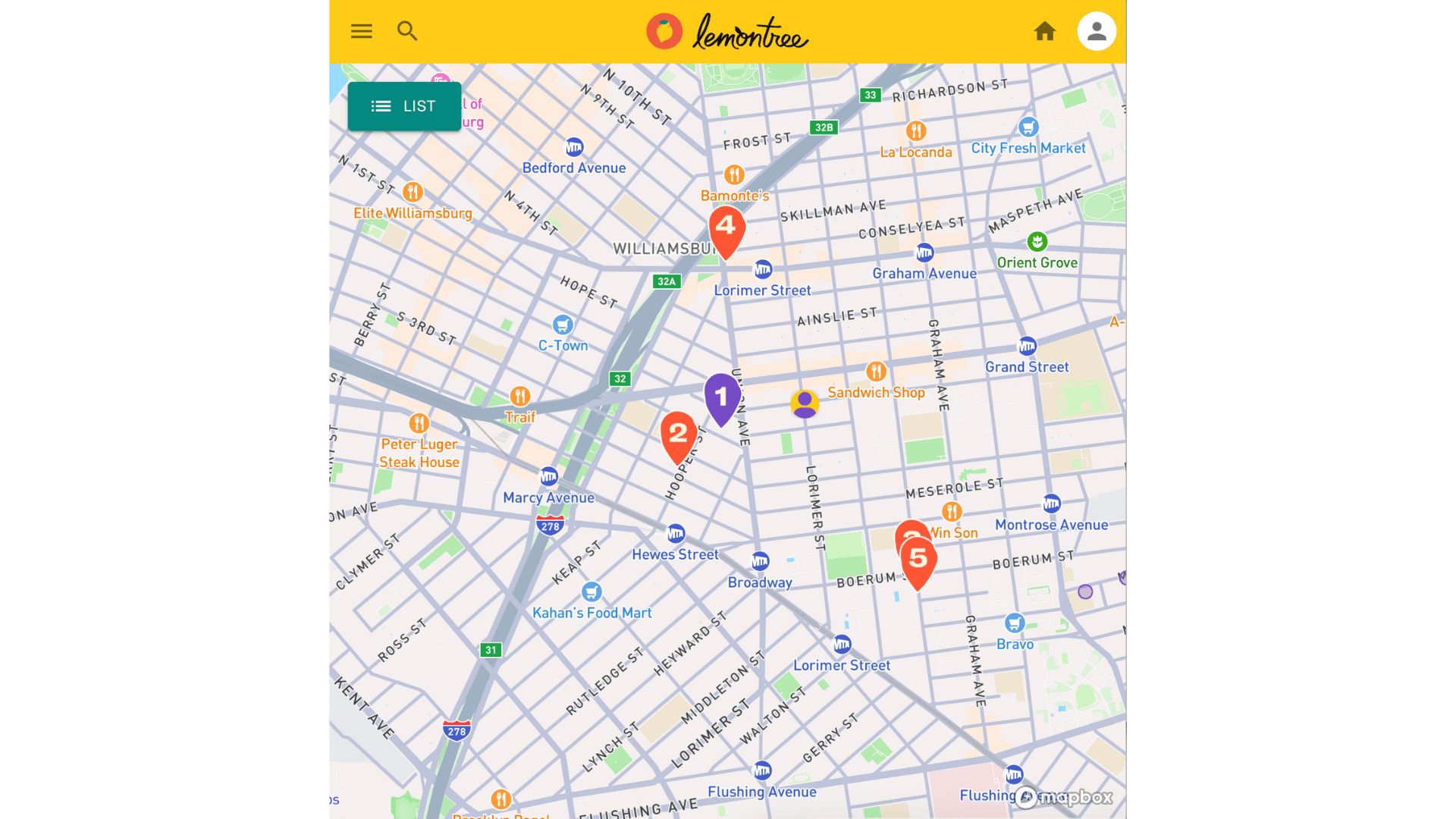
Lemontree moved the helpline to SMS to reach more neighbors, automatically texting lists of pantries that matched each person’s neighborhood and circumstances. On the backend, Lemontree developed an AI model that scores each pantry for each client based on four main factors: data confidence and recency, opening schedule, client experience ratings and feedback, and proximity. Initially, Lemontree used a straight-line ‘as-the-crow-flies’ distance measure, filtering to within a radius of seven kilometers. But the team soon identified opportunities to improve the user experience by adding in greater location intelligence.
Lemontree also learned that listing addresses and distance alone was not meaningful to many people. A location might sound far away based on its address but is actually only a five-minute walk away. Or a location that is technically nearby might be difficult to reach if it requires crossing a highway. Without maps, it was hard for people to visualize how close a resource really was and how they could get to it.
Mapbox provides flexible map options and nonprofit-friendly pricing
Lemontree’s CTO, Samuel Cole, drew upon extensive experience building hyper-local, map-driven applications. He knew that Mapbox offered exactly what the team needed: highly customizable maps, excellent coverage of pedestrian and urban details, flexible and accurate APIs for calculating travel time, and nonprofit-friendly pricing.
Mapbox is such an incredible part of our technology stack. Mapbox gives us the control of a modern product team, with the values and pricing that a nonprofit needs. We can style maps to feel joyful, reason about walking and vehicle trips instead of just raw distance, and use Boundaries data to help partners see their impact—all in one stack.
Samuel Cole, CTO, Lemontree
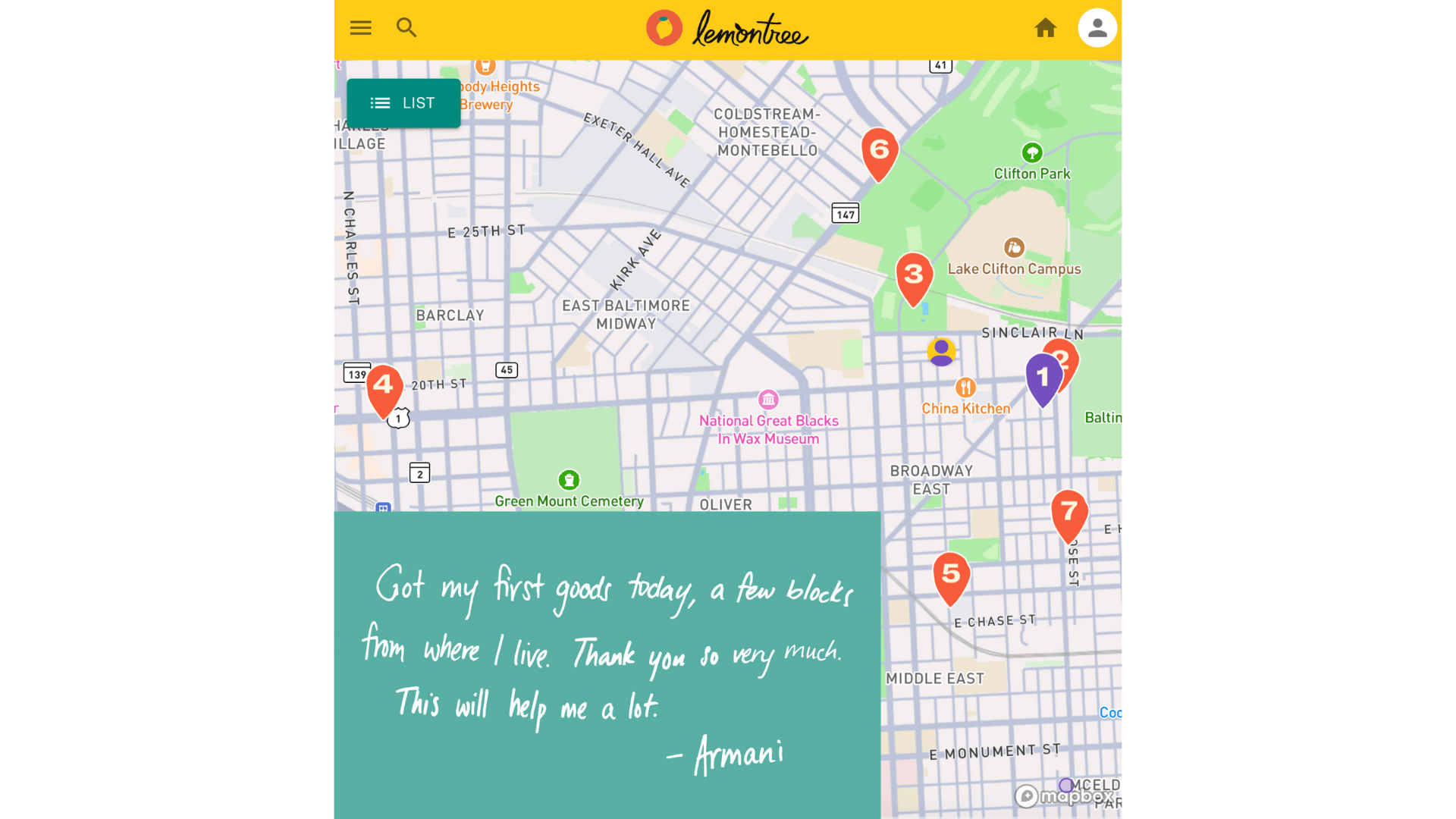
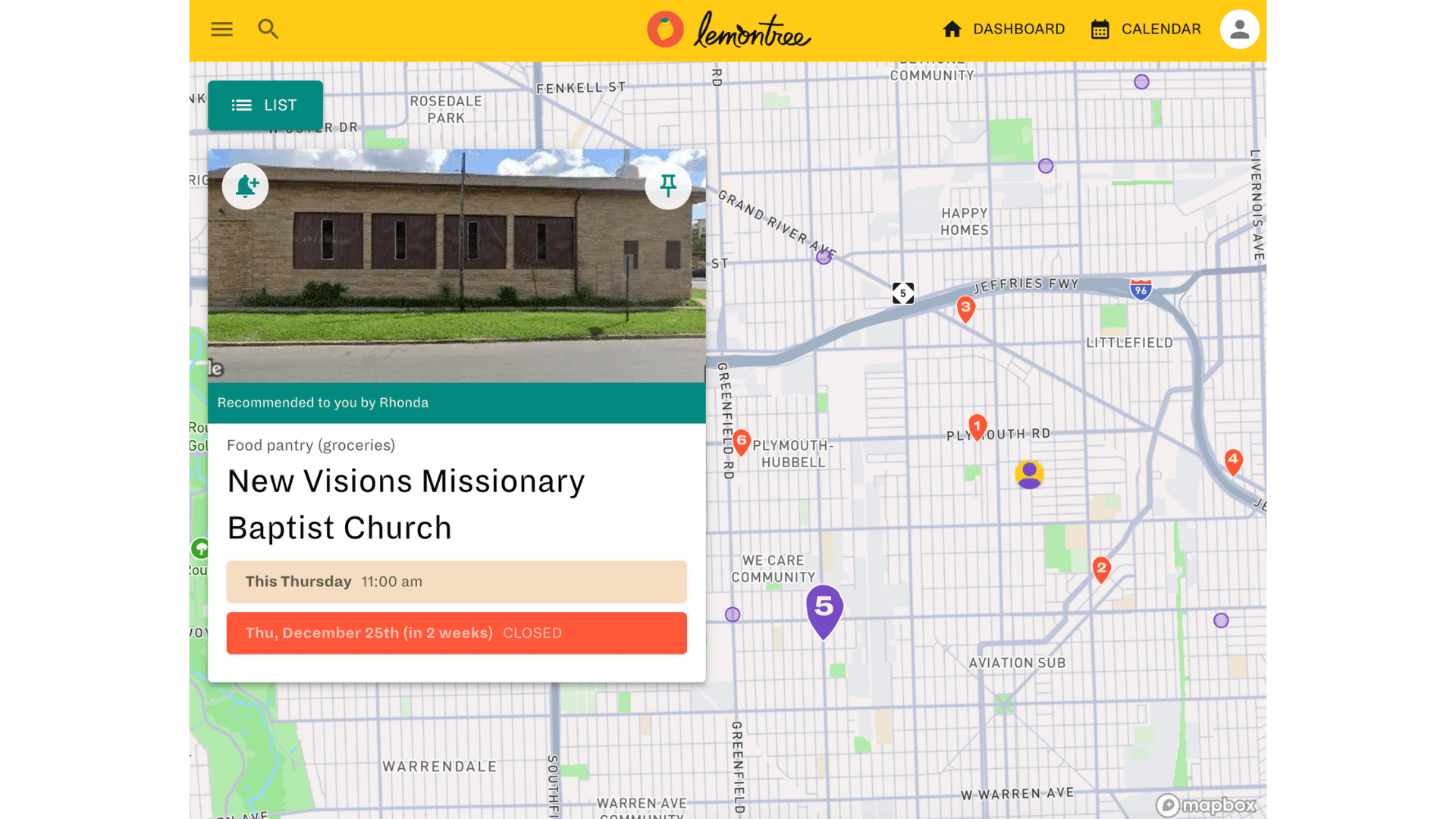
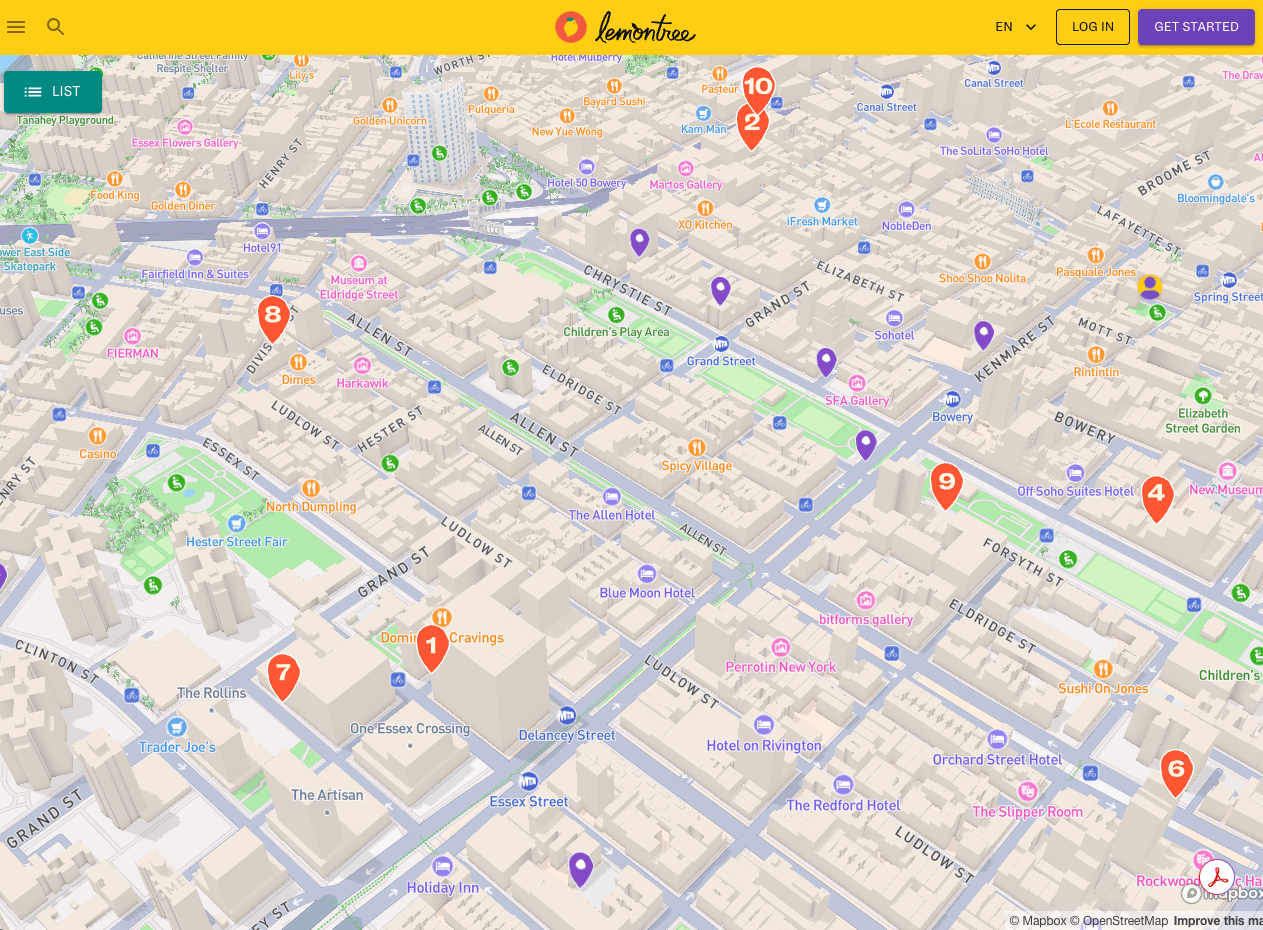
For SMS and WhatsApp messaging, Lemontree uses the Mapbox Static Images API to generate map images when recommending nearby food pantries—providing essential context while keeping performance fast and lightweight. On its website, Lemontree provides an interactive web map built using react-map-gl, community-supported components for building with Mapbox GL JS in React. The web map displays local food resources and allows users to toggle between a list and map view, search based on proximity to an address, and filter by opening days. On the directory pages for the website, the Mapbox Static Images API also provides snapshot maps in the ‘resource cards’ for each pantry, reducing the compute power to load a map image – which is important especially for clients who have older devices or constrained connectivity.
Welcoming and intuitive map design with the Mapbox Standard style
Lemontree was an early adopter of the Mapbox Standard map style, finding that its balance of realism and abstraction is a great fit for helping people to navigate using familiar landmarks without overwhelming them with visual noise. Using Mapbox Studio, Lemontree customizes map styling to match the organization’s joyful, visual identity: bright colors, friendly type, and hand-drawn icons that reinforce that food access can feel inviting, not clinical.
Mapbox Standard has been great for helping to navigate the real world. It’s the perfect blend of realism and representation – between having a street map versus satellite imagery. It sits in that perfect spot where you can really see the representation of the streets and routes you’re going to take and map it to the landmarks that are in your head from real life.
Sam Cole, CTO, Lemontree
Practical proximity information and ZIP code insights
Within its core recommendation engine, Lemontree relies on the Mapbox Directions API to estimate travel time to food pantry options. Switching from straight-line distance to travel-time calculations was a major improvement for communicating location options in a practical and intuitive way. The Lemontree team also tunes the API responses by routing profile: In New York City, most clients walk, so the model prioritizes walking time and pedestrian safety, while in other regions where driving is more common, the model switches to driving profiles.
We had a moment where one of our engineers was like, ‘What if we use travel time instead of as-a-bird-flies distance?’ And that was a real unlock for us. All of a sudden, it’s so much easier to understand when you replace saying 'this pantry is 0.136 miles away’ with ‘it’s a 3-minute walk.’
Samuel Cole, CTO, Lemontree
Lemontree also uses a Mapbox Boundaries tileset of ZIP code regions to visualize food pantry service areas and the reach of Lemontree’s support. The Boundaries tileset makes it easy to create map visualizations that support internal planning and communicate impact without revealing individual client locations. Operationally, using Mapbox Boundaries helps Lemontree account for food pantry eligibility restrictions based on ZIP code before making recommendations.
Mapbox has great support for nonprofits. And even without the nonprofit support, the Mapbox pricing is just so much better than the competitors…it makes it a more natural fit for a nonprofit. And it is as high quality or higher quality than anything else. Samuel Cole, CTO, Lemontree
Navigating to nourishment with joyful, intelligent maps
Since adopting Mapbox as a core part of its platform, Lemontree has scaled from a single phone line in New York to an on-demand service that supports thousands of households every day across eleven regions. Neighbors no longer need to decode address lists or guess how far a pantry might be. They can see options clearly on a map and quickly understand how long it will take to get there.
Maps also reinforce Lemontree’s ethos: food access should feel welcoming. Clients describe the experience of locating and navigating to food pantries recommended by Lemontree as simple, clear, and encouraging. For staff and partners, custom map visualization dashboards provide a clear view of coverage and impact without compromising privacy.
We started with one person answering phone calls. Today, thanks in large part to our Mapbox mapping stack, we help tens of thousands of households navigate to free food every day. And Mapbox lets us keep the experience joyful and dignified while we do it.
Samuel Cole, CTO, Lemontree


.jpg)
