Back to all cases

Mapbox powers the location experience for hundreds of thousands of ATLAS:EARTH players, delivering reliable performance at scale while freeing engineers to focus on other gameplay innovations.
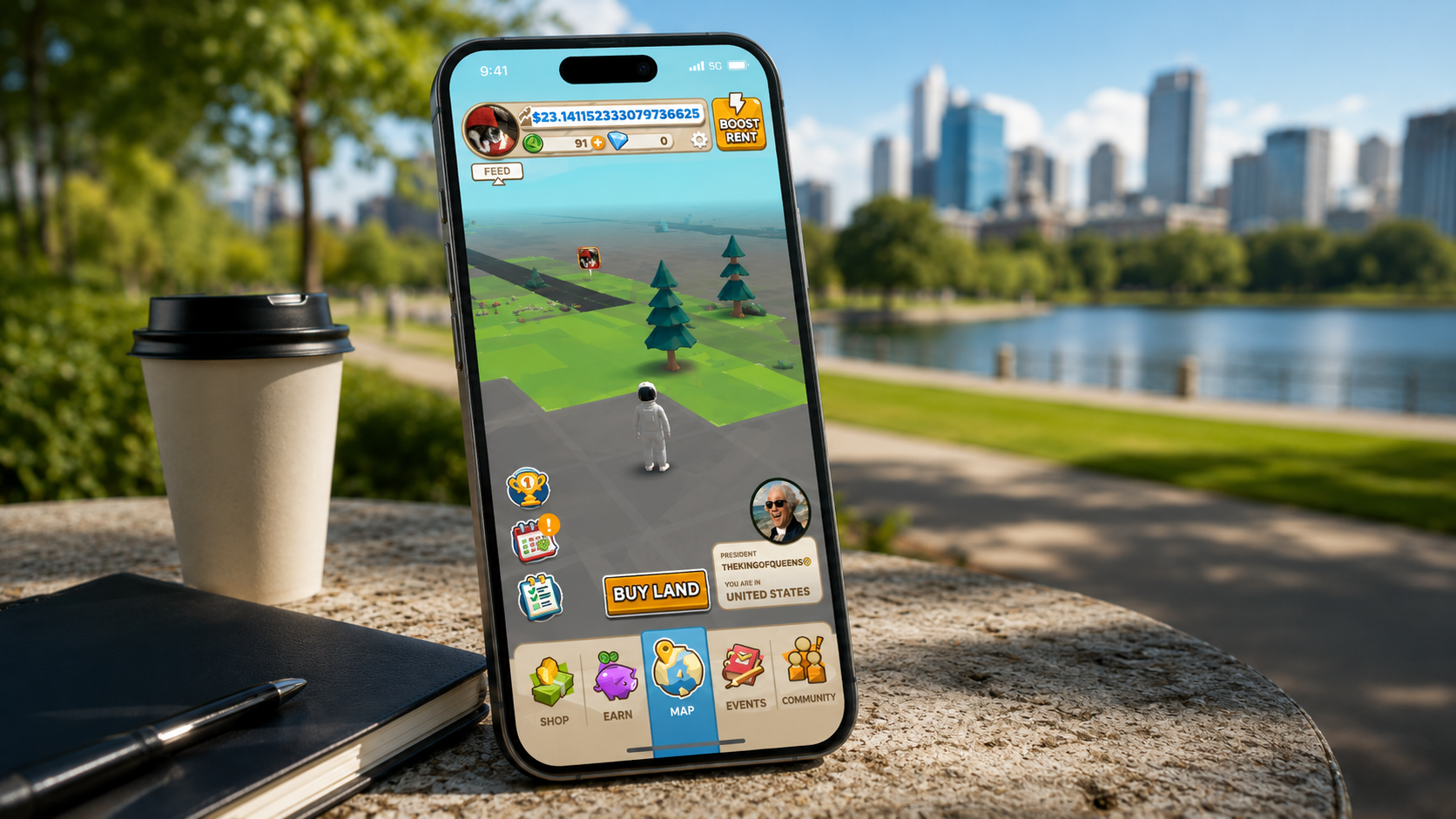
Key benefits of building with Mapbox
- Mapbox has helped ATLAS:EARTH grow to 723,000 monthly active players with a 5.0 customer satisfaction score.
- Mapbox reliably renders a global tileset for hundreds of thousands of daily players across 14 countries, giving Atlas Reality the performance and scalability it needs to grow.
- Mapbox has enabled a relatively small engineering team to focus on gameplay rather than mapping infrastructure.
products used
About Atlas Reality
For some mobile games, the map is simply a backdrop. For Atlas Reality, it is the game. Everything the game studio builds starts with real world locations that encourage exploration, discovery, and digital ownership.
The company's flagship title, ATLAS:EARTH, transforms the physical world into an interactive digital economy. Players purchase 30-by-30-foot parcels of virtual land mapped to real locations across the globe. As they expand their portfolios, those parcels generate virtual rent that can be redeemed for real cash, encouraging players to explore neighborhoods, cities, and landmarks in entirely new ways.
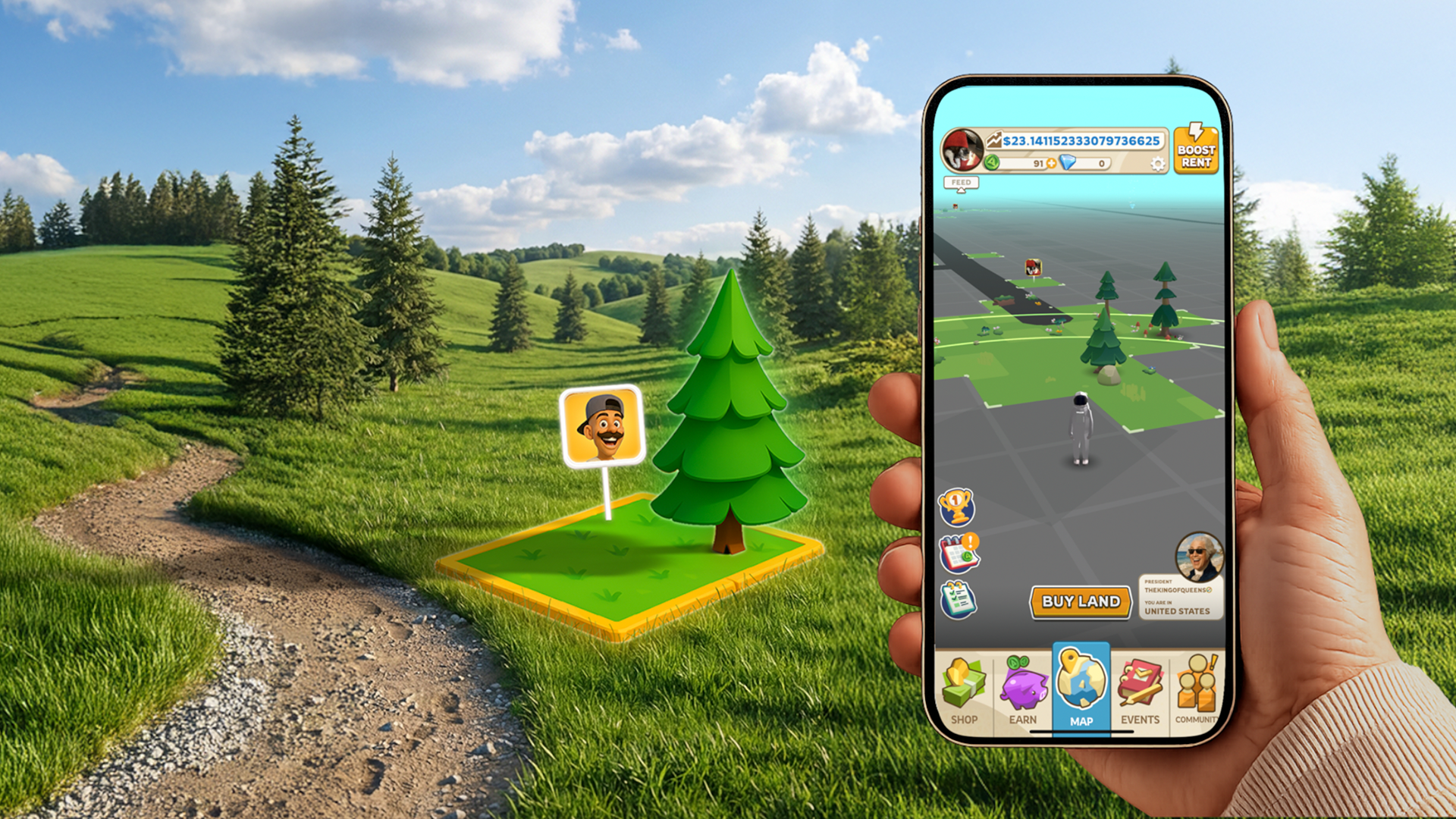
ATLAS:EARTH exists because the map is real. Every interaction depends on an accurate representation of the real world. When someone buys the exact parcel they're standing on, the world beneath them has to be accurate everywhere.
Morgan Moon, V.P. of Game Development at Atlas Reality
That requirement led Atlas Reality to build its location experience with Mapbox.
Building a game on top of the real world
The team needed to render an accurate, GPS-anchored representation of the planet inside a Unity mobile game while maintaining smooth performance across millions of potential locations worldwide.
Building and maintaining that geospatial infrastructure internally would have dramatically delayed development and diverted engineering resources away from gameplay. Instead, Atlas Reality chose to focus on building its game while relying on a location provider to power the underlying map experience.

Finding the right mapping foundation
Before adopting Mapbox, Atlas Reality experimented with open-source mapping libraries while developing an earlier game. Although functional, those tools relied primarily on OpenStreetMap data, and required more engineering resources than the team could support. They also lacked the performance, flexibility, and long-term support needed for a global mobile game. The team continued evaluating options before discovering the Mapbox Maps SDK for Unity.
Mapbox fit what we needed almost immediately. Rather than building map rendering ourselves, we could focus on building the gameplay, economy, and player experiences that make ATLAS:EARTH unique. Using an established mapping platform gave us access to professionally maintained global map data without the need to build and maintain our own geospatial data pipeline.
Morgan Moon, V.P. of Game Development at Atlas Reality

One of the biggest advantages of Mapbox has been enabling a relatively small engineering team to focus on gameplay rather than mapping infrastructure. Instead of spending years building global map rendering, vector tile pipelines, and geospatial tooling, the team was able to bring ATLAS:EARTH to market faster. They could also direct engineering resources toward the features that create other competitive advantages.
Rendering a planet inside a game
Atlas Reality uses the Mapbox Maps SDK for Unity to render the real-world environment surrounding every player on mobile. They use Mapbox GL JS to power maps on a companion web application. The Mapbox Search Box API empowers players to accurately search for specific locations in the digital world.
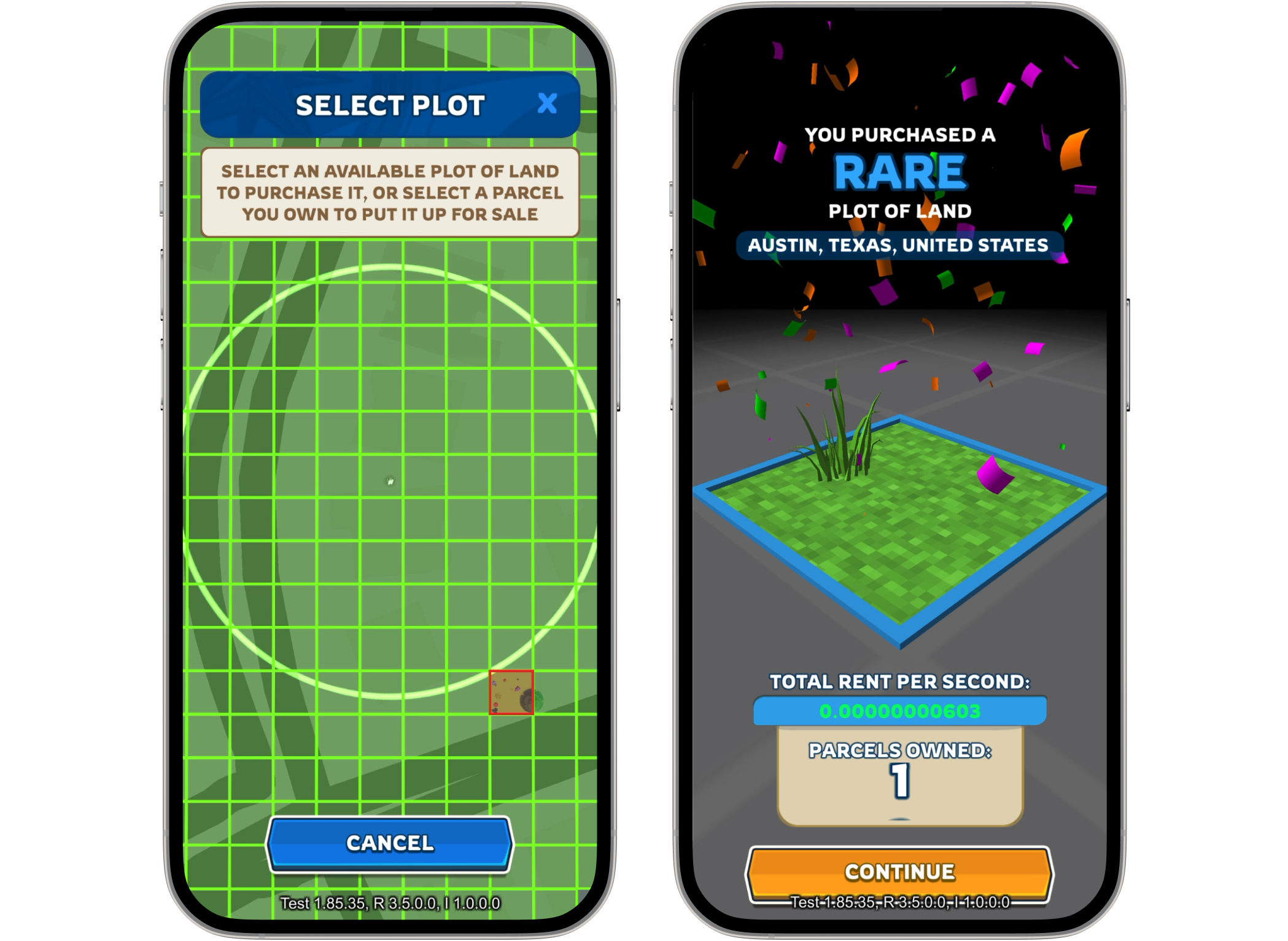
Rather than loading an entire city, the game renders a focused window of the player's surroundings using a 3×3 grid of vector map tiles centered on the player's GPS location. As players move, the map updates dynamically while remaining lightweight enough for smooth mobile performance.
On top of those map tiles, Atlas Reality overlays its own map design and parcel ownership system, allowing every 30-by-30-foot section of land to become a unique digital asset. The combination gives players a world that feels immediately familiar while supporting the game's digital economy.
The flexibility of Mapbox vector maps allows us to customize map styling to match the game's visual design without sacrificing geographic accuracy.
Morgan Moon, V.P. of Game Development at Atlas Reality
Supporting a growing global community
Mapbox has helped grow ATLAS:EARTH to 237,000 daily active players and 723,000 monthly active players across 14 countries. Approximately 110,000 digital land parcels are purchased in a single day. The game has a 5.0 customer satisfaction score (CSAT). Every parcel is a purchase of a specific real-world, geolocated plot, making Mapbox absolutely essential to driving revenue for Atlas Reality.
A successful implementation means the map just works. It performs dependably with a global tileset, for hundreds of thousands of players at any given time, in 14 countries. Mapbox has always offered us the reliability we need to scale.
Morgan Moon, V.P. of Game Development at Atlas Reality
Building the future of ATLAS:EARTH on Mapbox
Atlas Reality continues to rely on Mapbox as the geographic foundation of ATLAS:EARTH.
As the company explores future game experiences, new capabilities such as richer building data and detailed place information have opened discussions about how location technology could make future gameplay even more immersive.
For a game built around owning the real world, having an accurate digital representation of that world remains essential. And for Atlas Reality, Mapbox provides the foundation that makes that possible.


